Part 1 on a series about the Whitney’s
Those early Adirondack travelers were an intrepid, energetic bunch. Say you were an indigeneous hunter 500 years ago or a Boston banker on a fishing holiday a mere 150 years ago who wanted to go from Forked Lake to Little Tupper Lake. The route is only about 15 miles, but involves hopping from lake to pond to lake four times. One of the carries is 2 ½ miles long. But, oh, the fishing and hunting! And the scenery “fairly sparkles with picturesque attractions,” in the words of one early, White visitor. But very few people have traveled this glorious wilderness for almost 140 years. I speak, of course, of Whitney Park, which is now for sale and reportedly has a buyer. If the deal should fall through, or if public access is somehow restored, we might experience the Adirondacks as the earliest people did.
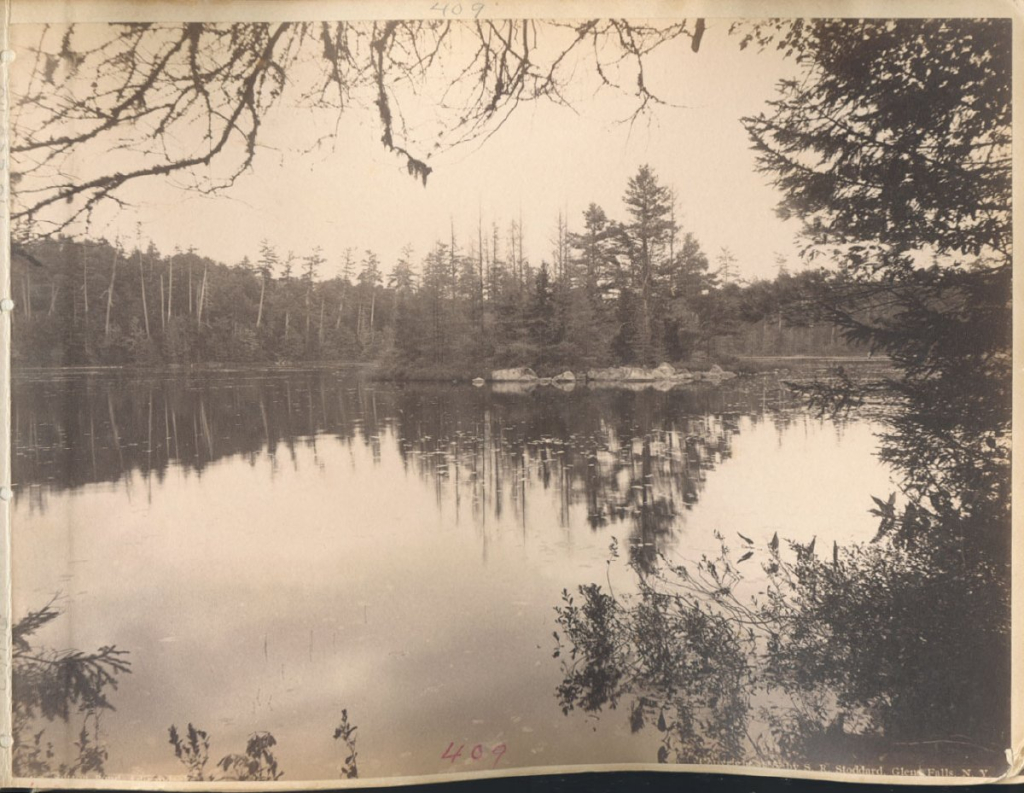
Illustration: Seneca Ray Stoddard, Bottle Pond about 1888
The earliest travelers through the area were the Iroquois and Algonquin on seasonal hunting and fishing expeditions. No written records remain of their routes, but the European-American trappers and market hunters who began exploiting the area after the American Revolution must have followed those same waterways and the carries between them. For a person with a light boat, a canoe or guideboat, they were the easiest ways through the wilderness. By the middle of the nineteenth century, a new breed of hunter began exploring these deepest recesses of the Adirondacks. They were men, mostly, who could afford to take off a month or two from work in the city and hire a local guide to use those same waterways and carries for a vacation of shooting deer, fishing for trout, and just “loafing.”
One of the earliest of these “sports” who wrote about his adventures was Joel Tyler Headley, whose The Adirondack, or, Life in the Woods described his trips in the 1840s. On one, he came from Martin’s on Lower Saranac with two companions and three guides via Little Tupper Lake through Rock Pond. Then, as we drew our boats forth on to the mountain side, I experienced an entirely new sensation. Hitherto in all my journeyings, the carrying-places of any length had always been along streams that, in the woods, you come to regard as a sort of companionship. Besides, they are unerring guides, leading you surely to another body of water which you know to be only a little way ahead. But to pull our boats into the woods with no path before us and no watercourse to guide us, and strike straight off along a mountain side, seemed a most extraordinary and somewhat venturesome undertaking.
Venturesome, indeed. He had embarked on one of the main historic routes through the present Whitney Park. From Little Tupper Lake, (formerly part of Whitney Park and now open to the public as the William C. Whitney Wilderness Area) he and his party rowed through Rock Pond, Bottle Pond, Sutton Pond, Cary Pond, Little Forked Lake, and Forked Lake. This is that 15-mile route with four carries.
As all Adirondack buffs know, William Henry Harrison Murray’s Adventures in the Wilderness; Or, Camp-Life in the Adirondacks, first published in 1869, started a “rush to the wilderness” and introduced the region to the general public. In the main part of his book, he urged the public to hire a guide and travel along the “great central valley” of the Adirondacks, from Saranac Lake to the Raquette River watershed and over into the Brown’s Tract and on to Old Forge, the route that inspired the 90-mile Adirondack Canoe Classic. In Murray’s short tales of adventure that are also included in the book, he hints at some of the routes he took with Long Lake guide John Plumley, several of which were enclosed twenty years later in Whitney Park. Others who followed were more specific about their routes.
Illustration: David Mix, of Long Lake, on Slim Pond about 1890
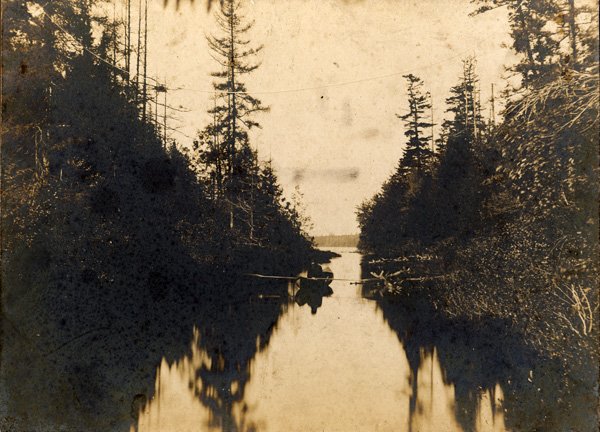
One such route on the present Whitney Park took travelers from Little Tupper to Long Lake. George Washington Sears, who wrote for Forest and Stream under the name of “Nessmuk,” paddled his 9 ½ foot canoe Sairy Gamp along this route in 1883. On Little Tupper, he asked advice of guide and hotel-keeper Pliny Robbins. Robbins gave him three alternatives, two of which would soon be enclosed in Whitney Park. One route was the one followed by Headley & Co., where there “was good fishing. The scenery was very fine.” The one Nessmuk chose was via Stony Pond and into Big Slim Pond, a route also noted by surveyor Verplanck Colvin in 1873. Nessmuk wrote about it,
[The entry to Slim Pond] was a mile long and so narrow that I brought in the paddle, laid it alongside, and made my way by pulling the canoe along by the weeds and water shrub on either side. It was a tedious job, but when I came out into the clear, bright waters and entire solitude of Big Slim Pond, I was well rewarded…. Big Slim Pond is a beautiful lake; narrow, long, and lonely. One may here catch all the trout any reasonable sportsman may desire, and all of a good size….
Big Slim debouches into Big Brook, which enters Long Lake where today the Long Lake Creative Arts Camp stands. Big Brook is only passable at high water, though, so some nineteenth-century travelers using this route carried over to Lake Eaton and thence to Long Lake by water and another carry.
The year after Nessmuk’s trip, medical doctor J.H. Hunt and two companions hired Long Lake guides John Plumley, Lorenzo Towns, and Cal Towns at the Forked Lake Carry for a trip via guideboats north through the heart of what is now Whitney Park. They spent the first night on Bottle Pond, making no mention of the trip with its three carries from Little Forked through Cary and Sutton, but the long passage from Bottle to Rock was over what he called “Dead Man’s Carry.” Murray had John Plumley describe the 3-mile route in 1869 as 3 miles long, “a mere trapper’s line,…it is n’t cut out; two miles and a half by blazed trees, and half a mile of slough.”
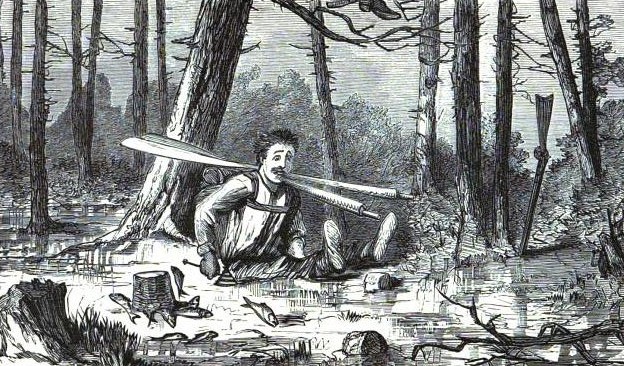
By 1895, water routes through the region—and their associated carries—were well known, thanks, in part, to guidebook-writer E.R. Wallace’s Descriptive Guide to the Adirondacks. In it, he wrote, “The Tupper waters are accessible from Lake Lila by three routes. Two of them are indirect and difficult, but possess the advantage of passing through some of the best sporting grounds of the Brown’s Tract region.” Wallace also gives gave practically step-by-step directions for three routes from Lake Lila to Little Tupper Lake which today would take a paddler or rower from the state-owned Lake Lila through the Whitney preserve. Lake Lila, formerly Smith’s Lake, was named by the new owner, William Seward Webb, who had built the Adirondack Railroad and then a great camp on the lake, renamed the lake “in compliment to his wife,” Eliza “Lila” Vanderbilt Webb in the early 1890s. The last stage of a long route with many carries is from Salmon Lake to Rock Pond. As Wallace warns, “This is the noted “Murray Carry”—rough, swampy, and difficult.” By the time Wallace wrote his guidebook, Murray’s Adventures in the Wilderness was almost 30 years old, and the chapter on “Crossing the Carry,” with the illustration below, was well-known.
Illustration: Illustration from W.H.H. Murray’s story, “Crossing the Carry,” 1869
Public access to the routes Wallace wrote about were becoming circumscribed even as he published his guidebooks. In the earliest versions (they went through 47 editions), he noted that travelers through what is now Brandreth Park “usually occupy one of the two Brandreth houses, both of which are very substantial, and conveniently fitted up with a view to the requirements of woodland life.” In 1882, however, he noted that the park and “shooting box” were no longer open to the public “as the privilege was abused.” (Emphasis mine.) “We wish to tender our thanks for the right royal hospitality once received here from the courteous proprietors,” he continued, perhaps hoping the Brandreths would change their policy.
It was also in the early 1880s that a group of wealthy, white sportsmen began meeting on Forked Lake, calling themselves the Hamilton Park Club. They purchased George Leavitt’s “Forked Lake House” and, as Wallace noted in 1895, “now the public is not entertained except with single meals.” Within a couple of years, the members were also excluded, except as invited guests. New York financier William C. Whitney, one of the early Club members, bought them out in 1897 and began a lumbering and vacationing venture that became Whitney Park.
William Collins Whitney was part of a phenomenon taking place across the Adirondacks, and across the nation. Clubs and private preserves in the mountains, like the first suburban country clubs being established at the same time, allowed people of means to ensure the company of social equals, increasingly important to them as large hotels and steamboats made an Adirondack vacation increasingly affordable to the middle class. Owners of the private clubs and preserves also criticized the state’s inability (as they saw it) to protect the fish and game in the region, an argument recently used by the last owner of Whitney Park in his refusal to sell to the state. As the Forest, Fish, and Game Commission wrote in its 1903 report, “the private preserves in the Adirondacks, with a slight exception, have been established within the last sixteen years—most of them within eleven years—and the comparatively sudden exclusion of the public from its old camping-grounds has provoked a bitter hostility on the part of the hunters, fishermen and guides who formerly ranged over this territory.”
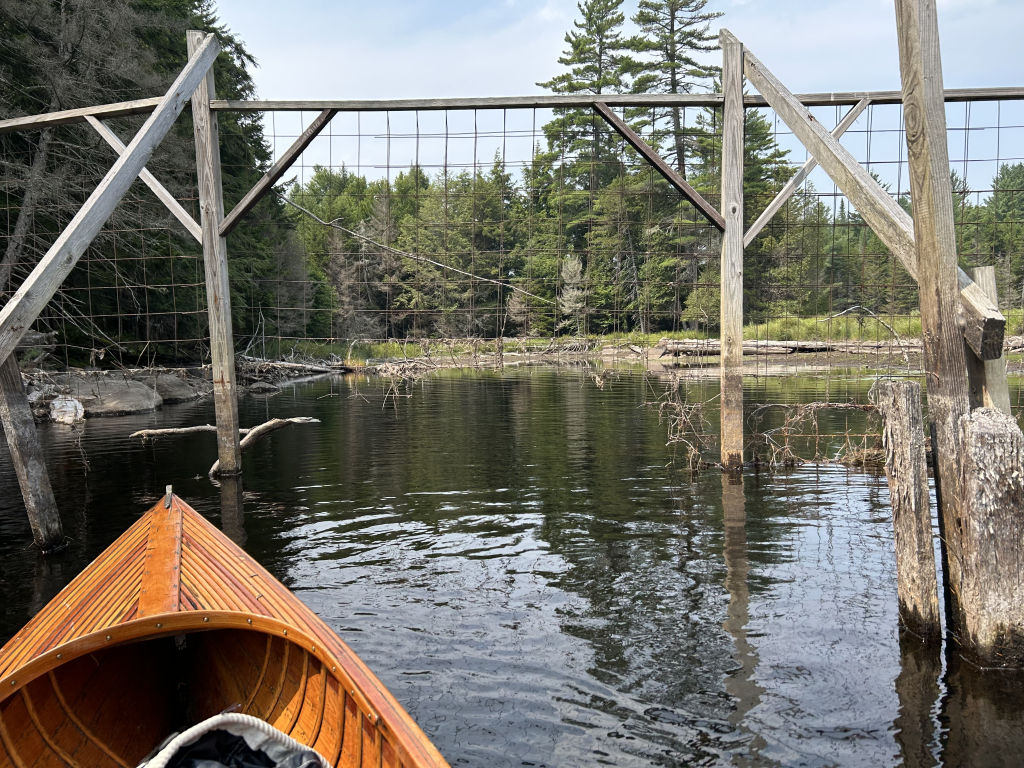
But the state could not, or would not stop the posting of private land. Whitney Park, in particular, grew under William C. and his son Harry Payne Whitney until it eventually contained 80,000 acres. William’s grandson, Cornelius Vanderbilt Whitney, known to Long Lakers and his guests alike as “Sonny,” enjoyed the sporting and also turned it into a profitable business after World War II. Whitney Industries mined gravel and cut timber, becoming a major employer in the area. And the Whitneys continued to guard their privacy, closing off access to waterways that once formed a network of transportation routes and fertile hunting and fishing grounds. As frequenters of Forked Lake know, they erected a fence across the formerly navigable outlet of Little Forked Lake, where stands their Camp Deerlands.
Illustration: Fence at Little Forked Lake outlet, 2025
Almost a century and a half after E.R. Wallace noted that the buildings on Brandreth Lake were no longer available to travellers, the property remains closed to the public. While modern canoeists probably would not presume to stay in one of the camps there, they are not allowed to cross a 1.8 mile stretch of the property on a stream that lies between two public waterways, Shingle Shanty Brook and Lilypad Pond, as determined in a 2019 court decision. This waterway is part of the great network used by the generations of travelers through the region that is presently enclosed in Whitney Park.
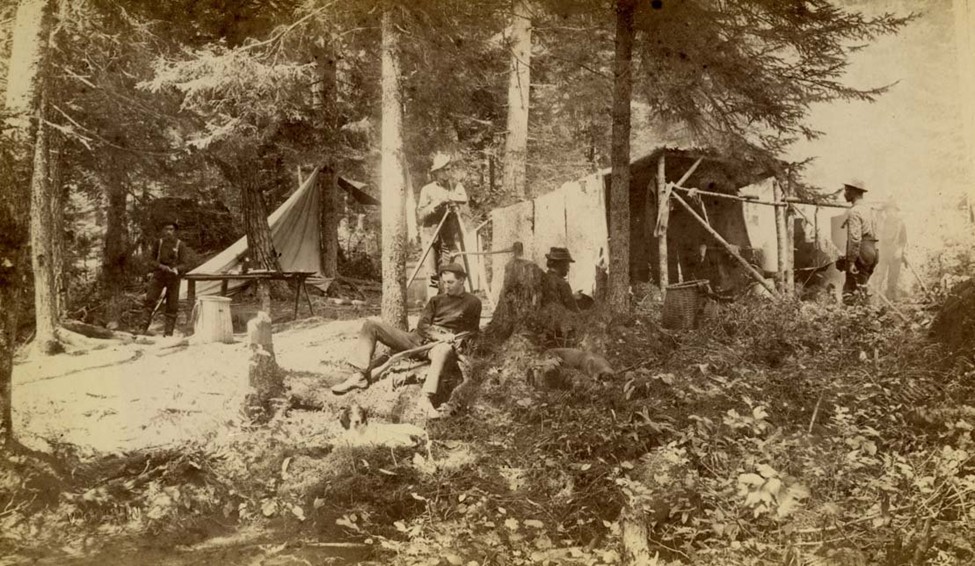
Illustration: Surveyor Verplanck Colvin’s party on the carry between Lilypad and Little Salmon, which is part of a route from Lake Lila to Forked Lake, 1888