Whitney Park Part II, Whitneys in Wonderland, the First Two Generations
Hallie Bond, Town Historian
William Collins Whitney’s name is familiar to present-day Adirondackers as the namesake of a wilderness area in the Town of Long Lake. 125 years ago, he was known as a wealthy, well-connected businessman who, like his peers, invested in a wide variety of ventures: investments in oil and tobacco, a contentious but lucrative involvement in public transit in New York City, and a stint as Secretary of the Navy under Grover Cleveland. And, of course, lumbering in the Adirondacks.

William Collins Whitney about 1890, when he started buying land in the Adirondacks.
By 1885, when he was in Grover Cleveland’s cabinet, W.C. Whitney was a member of what shortly became organized as the Hamilton Park Club. The Club, organized for sportsmen, owned 5000 acres in Township 35 and 20,000 acres in Township 36, encompassing part of the shores of the Forked Lakes, Plumley, Antediluvian, Sutton, and Cary Ponds, and a number of other waterbodies in the neighborhood. It had a clubhouse on Forked Lake which was also open to travellers for a meal until 1896. In that year, Whitney bought out the other owners, starting his land acquisitions in the Adirondacks. He planned to continue hunting and fishing, but also wanted to exploit the rich timberlands and gravel deposits for himself. Like other moneyed men investing in the Adirondacks at the time, Whitney intended from the start to combine pleasure with profit—or perhaps he saw it as using some of the profit to pay for his pleasure.
Whitney did not move into virgin wilderness. The neighborhood was already populated with other wealthy landowners and also was well-known to transient hunters and fishermen. Raquette Lake was rapidly becoming ringed with palatial yet rustic vacation homes, which have become known in our day as “great camps.” William West Durant, the prime mover of the style, had built Pine Knot starting in 1877, not long before Whitney started coming to the area. By 1896, it belonged to Collis P. Huntingdon, the railway magnate. Also summering on Raquette Lake when Whitney began establishing himself in the area were the family of Charles W. Durant, a cousin of William West at Camp Fairview and the family of woolen manufacturer Frank Stott on Bluff Point. J.P. Morgan owned Camp Uncas, to the south of Raquette.
Whitney’s newly purchased lands also included some summer homes. Camp Togus on Forked Lake (renamed Camp Buttercup by 20th century owner Bill Gross) and Howard Durant’s camp on Little Forked Lake (later the site of the main Whitney camp) were both part of the purchase. Not included at that point was the Durant-designed Camp Cedars, also owned by Howard Durant, another cousin of WWD. On its point in Raquette Lake it was surrounded by Whitney’s land.
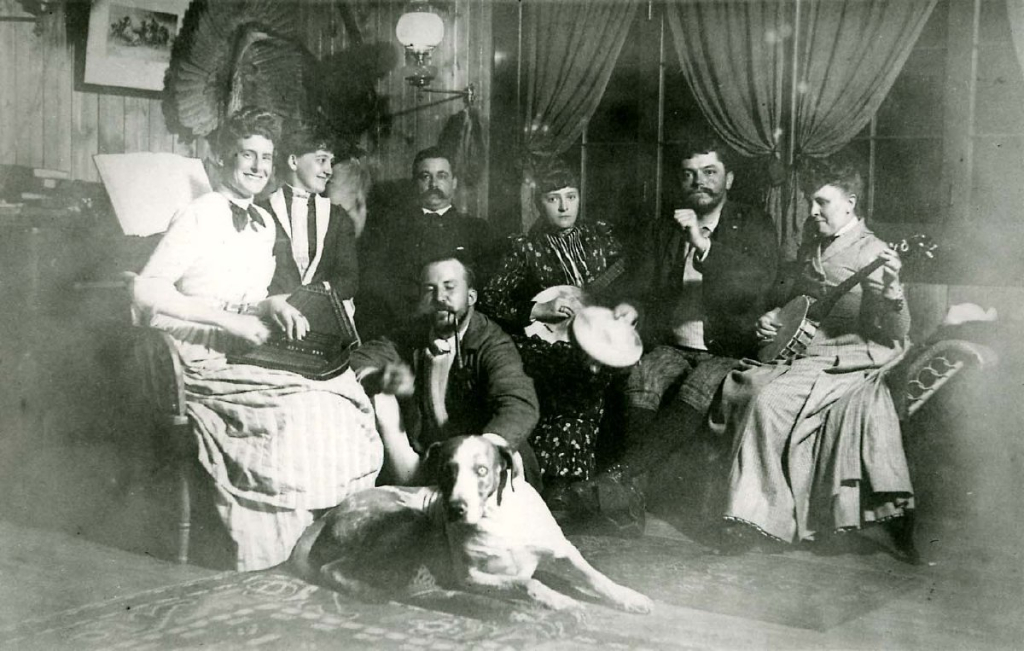
“A Musicale at Little Forked Lake (by flashlight).” Owner Howard Durant thumps the tambourine about 1888.
Initially, W.C. Whitney had a complicated journey to get to his new empire. He probably took T.C. Durant’s Adirondack Railroad to North Creek and then bumped by stage to Blue Mountain Lake, where he could take a small steamer through the Eckford Chain, stroll the boardwalk across the Marion River Carry, possibly stopping for a meal, and board another steamer for the Forked Lake Carry. Then he had another short walk (and possibly another snack) to Forked Lake, where he hired a guide and boat to take him to Little Forked Lake. We’re not sure if or how much he and his family used the Adirondack lands for pleasure during this period, but they probably did so after 1900. Starting in that year they could travel in comfort in Whitney’s private railroad car, Wanderer, straight to Raquette Lake on the new Raquette Lake Railway. Not surprisingly, the new line was primarily funded by W.C. and other wealthy camp owners in the region: Huntingdon, Morgan, and William Seward Webb, builder of the main line to which the branch line connected. W.C.’s son Harry Payne was also involved. When Durant went bust in 1902, they were among the new directors.
W.C. Whitney enjoyed his wilderness empire, particularly by water. When he began lumbering the parcel (about which more in the next installment), he specified that no trees should be cut within 200 feet of a lake or pond. The story goes that while rowing on Forked Lake with his son and heir Harry Payne Whitney one day, he said to Harry that Whitney Park was the one part of his holdings that he wanted to remain in the Whitney family forever.
William Collins Whitney died in 1904, leaving his Adirondack empire (and much else besides) to Harry. Part of Harry’s inheritance was the private car, and he added up-to-date boats to the estate, as well. About 1911, he brought a 35-foot Elco electric launch to Raquette Lake so he wouldn’t have to wait on the steamboat schedule. In 1924, when his 175-foot ocean-going steam yacht Whileaway got a new tender, the old one, also named Whileaway, was taken up to the camp. It is unknown whether the glass cabin launch cruised Big or Little Forked Lake; unless the channel between was dredged she couldn’t have gotten through.
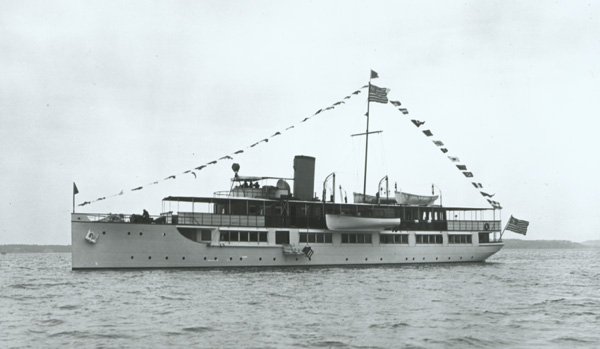
The gasoline tender Whileaway hangs from davits on the side of the mother ship in this photo from the Mariner’s Museum taken between 1915 and 1925. The tender was the first boat in the Adirondack Museum’s collection in 1956. Imagine her cruising on Forked Lake.
Both Harry and his wife, the sculptor Gertrude Vanderbilt Whitney, had many other interests competing with time in the Adirondacks. Harry’s preferred pastime was horse racing and Gertrude’s was art. They did either enlarge or raze and build anew Camp Deerlands on Little Forked Lake for their main camp. In 1934, Gertrude used Camp Deerlands as a hideout for her young niece Gloria Vanderbilt during the sensational custody trial between Gertrude and her sister-in-law, Gloria’s mother.
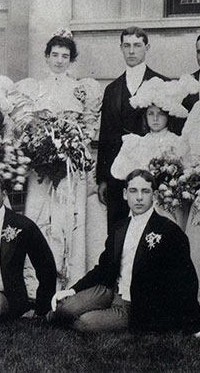
Gertrude Vanderbilt and Harry Payne Whitney were married in 1896.
If he didn’t fully share his father’s hunting and fishing interests, Harry Payne Whitney did share his interest in making money off the estate. His father had begun logging the property almost as soon as he purchased the first parcel, and Harry continued the contracts. He built a railroad to move hardwood from Rock Pond west across Brandreth Park to the New York Central line, and drove softwood logs by water to the mills at Tupper Lake.
We’ll explore that story in the next installment.